The Engineering Behind Your Next Racket
Specs over marketing claims: Proprietary carbon layups, tungsten inserts, and dampening systems modify performance by marginal, often unmeasurable amounts. To select the correct frame, three variables must be prioritised: Swingweight, RA Stiffness, and Balance Point.
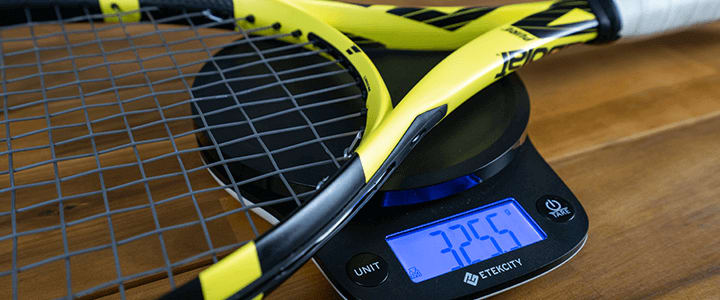
Static weight vs. swingweight: A 270g head-heavy frame and a 320g head-light frame can produce identical swingweights. On-court feel is determined by mass distribution along the frame's length, not total mass at rest. Selecting a frame based solely on static weight is the single most common purchasing error at every level of the game.
Understanding frame flex: A higher RA rating (68–72) returns energy to the ball faster, producing measurable power gains on slower swing speeds. The mechanical consequence is increased vibration transmitted to the wrist, elbow, and shoulder on off-centre contact. Players with prior elbow or shoulder strain should remain below RA 65. No dampening system eliminates this; reducing RA is the only effective intervention.
SwingweightStatic Weight vs. Swingweight
Swingweight (measured in kg·cm² on a Babolat RDC) is the rotational inertia of the frame as it pivots through the stroke arc. Static weight is the figure on a postal scale. They are independent variables — one describes mass, the other describes how that mass behaves in motion.
Plow-through and contact stability
Plow-through — a frame's resistance to deflection on impact with a fast-moving ball — is a function of swingweight, not static weight. A 285g frame at swingweight 330 will hold its line through a heavy topspin ball more effectively than a 315g frame at swingweight 295. This is why static weight in isolation is an insufficient basis for evaluating stability at the contact point.
The 2026 tour reflects this directly. Players including Alcaraz and Sinner use 100 sq in heads at swingweights of 330–345 kg·cm². This "Modern Player" specification combines the larger string surface of a mid-plus head — which increases spin potential and margin on mis-hits — with the contact stability of a high swingweight. The 93 sq in players-frame at sub-300 swingweight is no longer the default elite configuration.
RA RatingUnderstanding Frame Flex
RA (Racket Advisory stiffness) measures frame deflection under a standardised load. The scale runs from approximately 45 (high flex) to 75+ (minimal flex). The number describes how quickly energy is returned to the ball on impact — and by direct consequence, how much vibration is transmitted to the player's arm when contact is off-centre.
What dampening technology actually does
Vibration transmitted through the frame during impact occurs in the first milliseconds of contact — before any mechanical dampening system can respond. Proprietary carbon weaves, graphene inserts, and silicone dampening chambers address frame resonance frequency after the ball has left the string bed. This affects perceived sound and residual buzz, not the primary vibration load. Reducing RA is the only modification with a clinically meaningful effect on arm load.
BalanceThe Mechanics of Maneuverability
Balance is recorded in millimetres from the butt cap to the balance point, then expressed as points relative to the frame's geometric mid-length. 1 point = ⅛ inch. A frame at 7 pts head-light (HL) has its balance point ⅞ inch below the frame's midpoint.
The practical effect: moving mass from the hoop to the handle lowers swingweight for any given static weight. 7 pts HL is the standard for all-court versatility — enough hoop mass to drive through baseline exchanges, fast enough through the arc to reach net volleys under time pressure.
Head-heavy balance is not a design error. For a 265g frame where total mass is insufficient to generate plow-through, shifting the balance point towards the hoop increases swingweight to compensate. This is rational for game-improvement frames. The issue arises when advanced players continue using head-heavy configurations past the point where swing speed and technique would benefit from the control advantages of a head-light setup.
Modern spec table — three player profiles
These are engineering targets, not brand endorsements. Any frame meeting these specifications performs the stated function regardless of manufacturer. All values are for strung frames at reference tension.
| Profile | Static Weight | Head Size | Balance | Swingweight | RA | String rec. |
|---|---|---|---|---|---|---|
|
Baseliner Power / Spin High swing speed, heavy topspin, full-court rallying |
305–325g | 98–100 sq in | 5–8 pts HL | 330–350 | 60–67 RA | Full poly, 48–52 lbs |
|
All-Court Control / Feel Net approaches, varied ball-striking, tactical variety |
295–315g | 98–102 sq in | 7–10 pts HL | 315–335 | 58–65 RA | Hybrid: poly mains / gut crosses, 50–54 lbs |
|
Game Improver Forgiveness / Accessibility Developing technique, slower swing speed, extended sessions |
265–285g | 104–110 sq in | Even to 4 pts HH | 295–315 | 65–72 RA | Multifilament, 52–56 lbs |
Swingweight values measured on Babolat RDC at 10cm pivot. RA values from TWU database, cross-referenced with in-lab flex measurements. Static weights are strung. Balance in points HL = points head-light from geometric mid-frame.
StringsHow String Selection Alters Frame Performance
The RA rating is a measurement of the unstrung frame. String tension and string material modify the effective stiffness of the hitting surface by a margin equivalent to 6–8 RA points in either direction. A player who selects a 64 RA frame for reduced arm load and strings it with a stiff polyester at high tension has produced an effective hitting surface closer to 70 RA. This is the most common and most preventable equipment error at club level.
Tension retention vs. durability — two separate variables
Players frequently conflate these. A string that resists breakage is not necessarily one that holds tension, and vice versa.
| String type | Tension retention (48 hrs) | Durability (breakage) | RA effect |
|---|---|---|---|
| Polyester | Loses 8–12% within 24 hours. Effectively dead by 6–8 weeks. | High — rarely breaks; plays dead long before breaking | Raises effective RA by 4–8 pts |
| Natural gut | Best retention in the market — holds 90%+ over 4 weeks | Low — breaks quickly, particularly in wet conditions | Reduces effective RA by 4–6 pts |
| Multifilament | Moderate — loses 10–15% over 4 weeks | Low to moderate — breaks before going dead | Neutral to slight RA reduction |
| Hybrid (poly mains / gut crosses) | Poly mains anchor tension; crosses preserve feel | High mains durability; crosses may fail first | Moderate increase — less than full poly |
Restring polyester frames every 8–12 weeks regardless of string breakage. A polyester string that survives four months is performing well below its strung tension. Continuing to use it is not a cost-saving measure — it produces inconsistent response and compounds the arm-load issue the player was likely trying to address.
Methodology: All swingweight values measured on Babolat RDC at 10cm pivot point. RA values sourced from TWU database and confirmed with in-house flex measurement where discrepancies exceeded 2 points. String tension loss data from controlled conditions at 20°C, 50% relative humidity. No manufacturer relationships influence spec ratings or editorial content.